Returns & Refunds
Part of Dropshipping customer service
Tracking repeated support issues by product
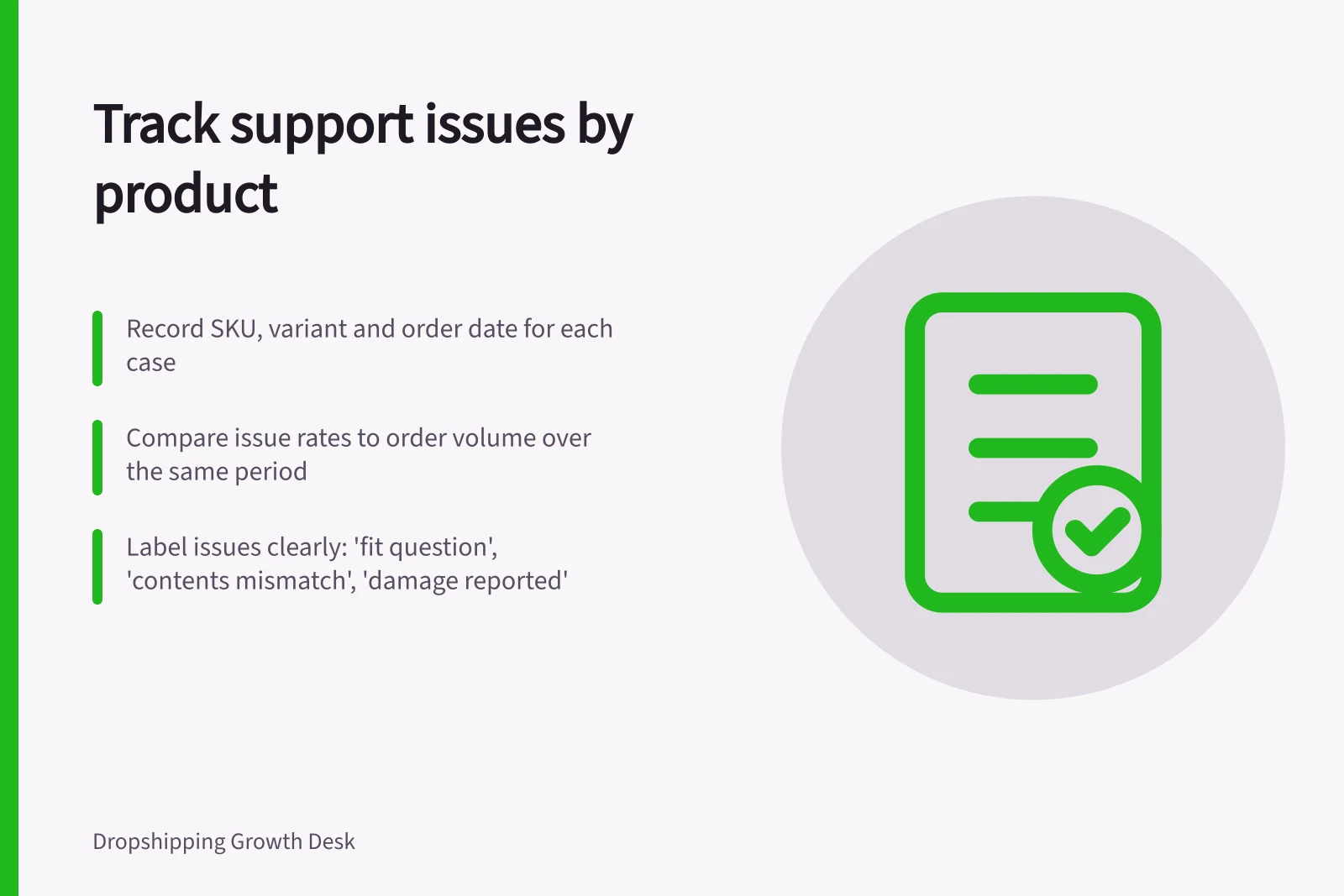
Tag support cases by product, compare them with orders and investigate repeat problems before changing a listing or supplier process.
Track support issues against the exact product and variant sold, then compare them with order volume. Repeated complaints can point to an unclear listing, a product mismatch or a fulfilment problem. The case count alone does not identify the cause.
Give every case a usable label
Record the store SKU, supplier SKU, variant and order date. Add an issue label that describes the customer’s problem, such as “fit question”, “contents mismatch”, “damage reported” or “dispatch uncertainty”. Keep the customer’s account and the confirmed finding as separate fields. A damage report remains a report until it is assessed.
Use labels that support a decision. “Other” can hold unusual cases temporarily, but review it so a repeated pattern does not disappear there. If one order has two unrelated problems, tag both and keep the order identifiable as one order.
Read counts with their denominators
Review cases by product and issue type alongside the number of orders for the same product over the same period. For an order-based rate, divide the number of orders affected by an issue by total orders, counting each order once for that issue.
Track total support cases separately: one order can generate more than one case. Cases divided by orders is a different measure and can exceed 100%. State the period and counting rule with either measure.
Small sales volumes can make a rate jump after a single report. Inspect the underlying records before treating a change as a trend. Compare variants separately when they have different materials, sizes or suppliers.
Include open cases in the review, but distinguish them from confirmed outcomes. Look at dates as well as totals. A cluster after a packaging change may need a different investigation from questions spread evenly over time.
Turn patterns into a specific check
Match the issue to the next useful question. Repeated fit queries call for a check of the published dimensions and compatibility wording. Reports of missing accessories call for a comparison of the listing, supplier contents list and what customers received. Dispatch complaints call for a review of accepted orders and the promises shown to buyers.
Australian guidance says product descriptions, images and delivery claims should be accurate. A confirmed mismatch should prompt a correction to customer-facing information. If an issue suggests a safety concern, escalate it promptly for an item-specific assessment rather than waiting for a higher case count.
Choose an action and record its owner: clarify a listing, request supplier evidence, pause an uncertain claim or examine a particular batch. Note when the change took effect. Then compare subsequent cases using the same definitions. Fewer reports after an edit may be encouraging, but a short period or lower sales volume cannot prove the problem is fixed.
Investigating repeated support issues
- Identify recurring issue typee.g., 'contents mismatch'
- Verify listing, supplier data and delivery promiseCross-check against actual customer receipt
- Take corrective actionUpdate description, request supplier evidence, pause claim
- Record owner and change dateEnsure accountability and tracking
- Monitor post-change case volumeUse same definitions to assess impact
Protect the people in the records
For product-level reporting, use the case details needed to investigate and summarise patterns without unnecessary names, addresses or message histories. Restrict access to customer information and follow the store’s retention rules. OAIC guidance for organisations covered by Australian privacy law advises limiting collection, disclosure and access to what is needed.
Protecting personal information in records
- Remove names, addresses and message history from reportsOnly include necessary case details
- Restrict access to customer dataFollow store retention rules
- Limit collection and disclosure to what’s neededAlign with Australian privacy law