Returns & Refunds
Part of Dropshipping supplier agreements
Agreeing on responsibility for damaged shipments
Set supplier duties for damage evidence, packing, claims, credits and replacement costs while handling the customer's rights separately.
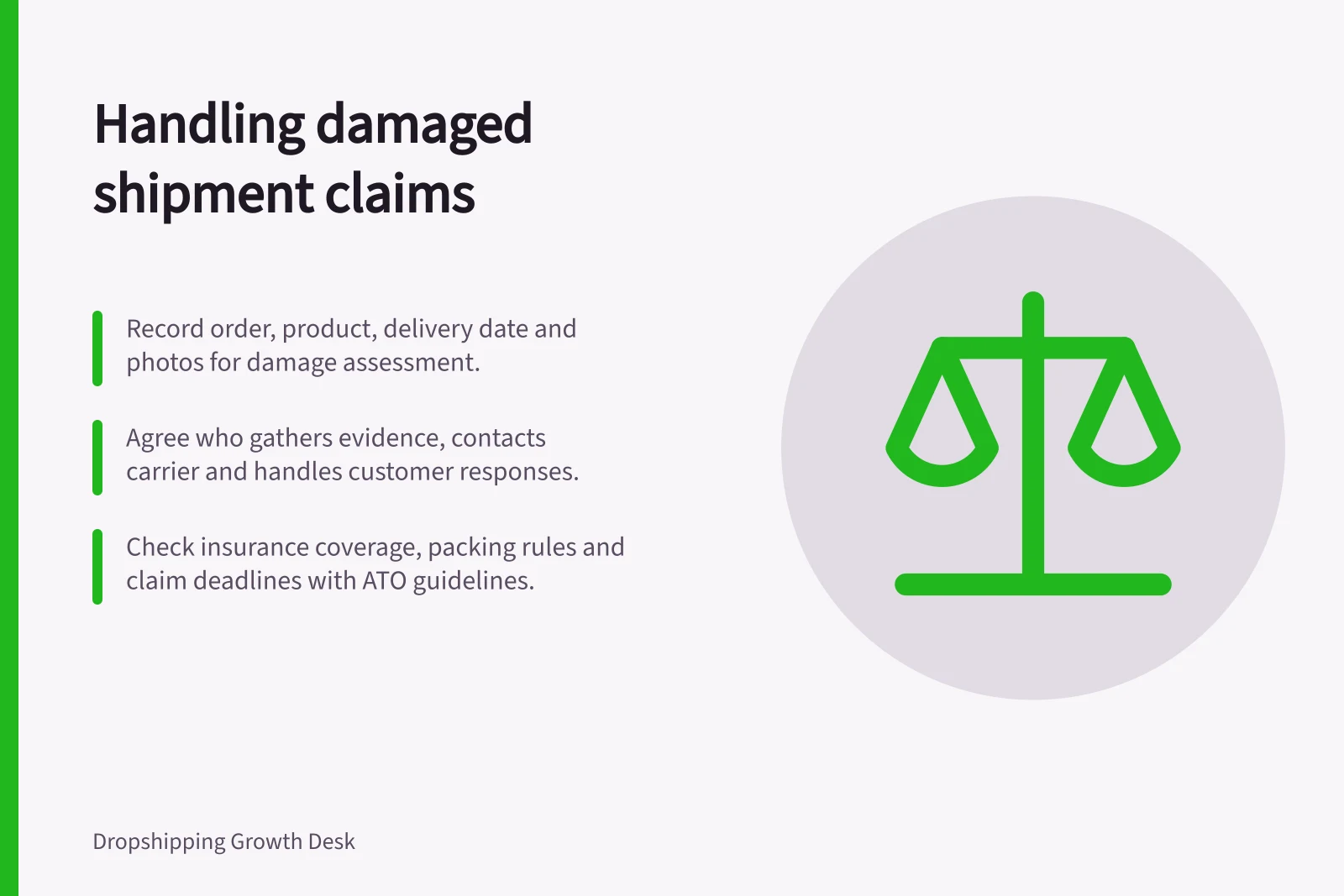
Agree who gathers evidence, contacts the carrier, arranges a replacement or credit, and pays each resulting cost when a shipment arrives damaged.
Give the store a way to respond to its customer while any supplier or carrier claim is investigated. A dented carton alone does not establish product damage, and visible damage does not always show where it occurred.
Separate the customer case from the supplier claim
Ask what arrived and what is affected. Record the order line, product and variant, delivery date, condition of the item and packaging, and useful photographs. Request only evidence needed to assess the problem. A damaged carton, broken item and missing component may call for different questions.
Record what the customer says and what remedy they are seeking. The appropriate response depends on the facts; get advice if the position is unclear.
Decide the customer's response separately from whether the supplier or carrier later accepts a claim.
Key facts about consumer rights and damage claims
- Consumer guarantees under Australian lawRight to repair, replace, refund or cancel if product is faulty
- ACCC roleEducates consumers and accepts reports; does not resolve individual disputes
- Visible damage ≠ damage originA dented carton doesn’t prove product damage; damage may occur at any stage
- Insurance claimsExistence of insurance doesn’t guarantee coverage; check policy terms
Allocate the work and costs
| Step | Agreement question |
|---|---|
| First report | Who receives it, and which order and parcel identifiers are needed? |
| Evidence | Which photographs, packaging details or carrier records are useful, and who obtains them? |
| Assessment | Who checks the item and by when? |
| Customer action | Who can authorise a response without waiting for a carrier decision? |
| Supplier settlement | Which item, freight, return, handling and replacement costs are creditable, and when? |
Agree on a route for disputed causes. The supplier and carrier may give different accounts of packing and transport.
Require a response that identifies the evidence relied on and the next contact for escalation. Keep an owner for the customer case while that dispute continues.
Check packing and insurance assumptions
Specify packing requirements for the relevant product, including protection for fragile parts, secure closure and correct labelling. Record how changes to essential packaging specifications will be approved.
If either party expects goods-in-transit insurance to cover damage, check the policy for these shipments. Establish who is insured, the route covered, exclusions, claim deadline, evidence requirements and excess. Insurance may offer recovery; its existence is not proof that a particular loss is covered.
Agree where a damaged item may need to go for inspection, repair, return or safe disposal. Apply that process to the case only after assessing the item and the customer's rights.
The ACCC educates consumers about their rights and responsibilities under the consumer guarantees, and accepts reports about businesses. It does not resolve individual disputes or give legal advice about a consumer's right to a repair, replacement or refund for a faulty product or service.
Review damage cases against the agreed process. If claims repeatedly fail because evidence or packing requirements are unclear, revise the relevant term and supplier instruction.
Essential steps before shipping fragile goods
- Specify packing requirementsInclude protection for fragile parts, secure closure, correct labelling
- Document approval processRecord how changes to packaging specs are approved
- Verify insurance coverageCheck policy for route, exclusions, claim deadline, excess, evidence requirements
- Agree on disposal or repair pathApply after assessing item and customer rights