Returns & Refunds
Part of Dropshipping product compliance
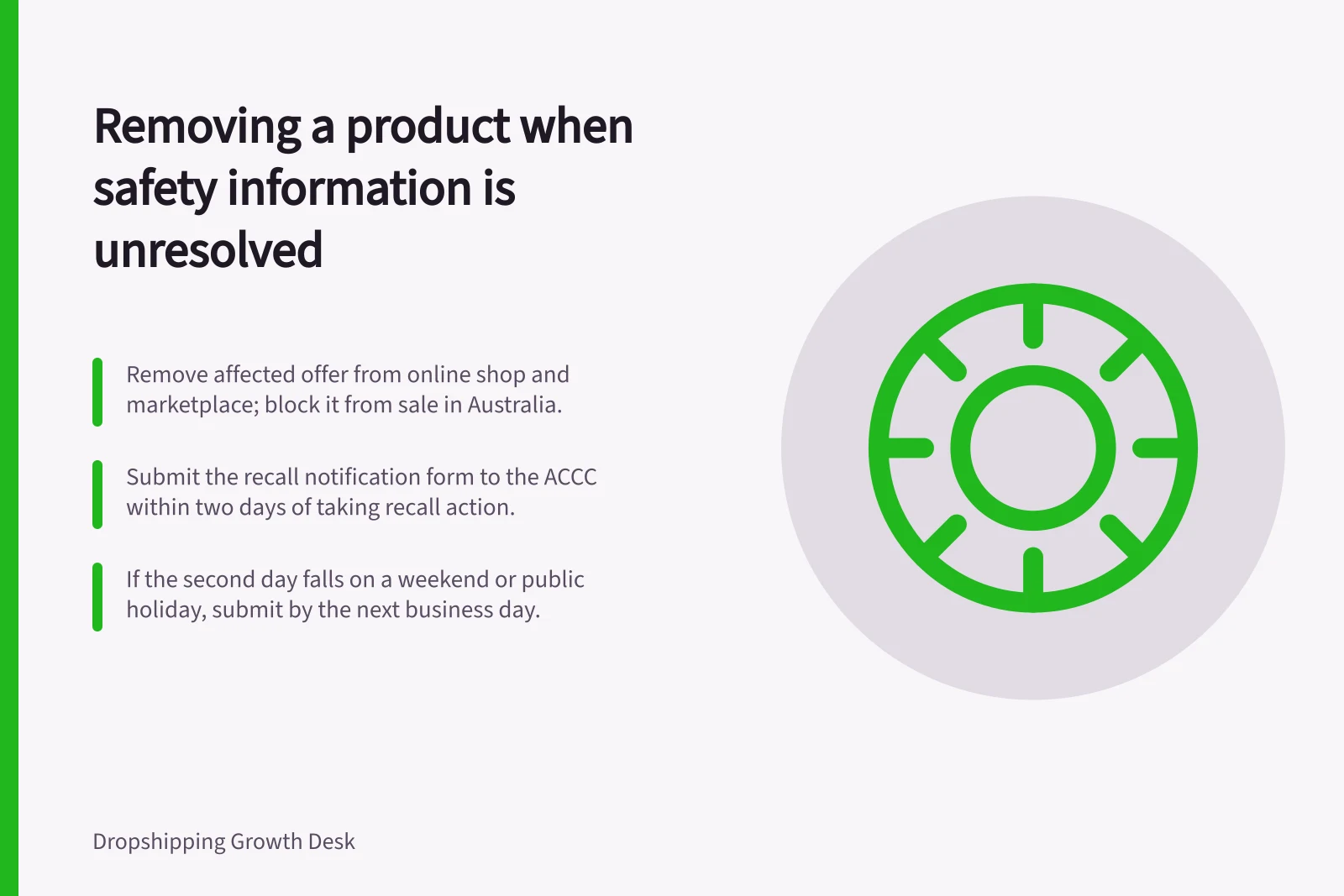
Removing a product when safety information is unresolved
Pause affected sales, trace open and completed orders, assess customer risk and reporting duties, and document when sales may resume.
If a credible safety concern about a dropshipped product remains unresolved, pause sales and remove the affected listing while you assess the risk. Online sellers must stop selling unsafe products and block products that do not comply with Australian product safety regulations from sale in Australia. Removing the offer prevents new purchases; it does not resolve the position of products already supplied.
Record the concern and affected stock
Capture the report and its source. Is the concern a possible hazard, a rule the item may breach, a report that does not match the stock, a missing warning, or a supplier substitution? Treat a customer report as distinct from a confirmed finding, but act promptly on a credible risk.
Identify the supplier SKU, model or revision, variants, packaging and possible batches. Ask which units are held, allocated to open orders, in transit or already dispatched, and preserve listing and supplier records needed to reconstruct the decision.
Check Australian recalls for a notice affecting the exact product or variant, and include any matching notice in your assessment.
Recording the concern and affected stock
- Capture the report and its source
- Classify the concernpossible hazard, suspected rule breach, report that does not match the stock, missing warning, or supplier substitution
- Identify the supplier SKU, model or revision, variants, packaging and possible batches
- Establish which units are held, allocated to open orders, in transit or already dispatched
- Preserve listing and supplier records needed to reconstruct the decision
- Check Australian recalls for a notice affecting the exact product or variant
Pause sales and dispatch
Remove the affected offer from your online shop and any online marketplace where it is listed, and block the product from sale in Australia. Check the buyer-facing page, option selector and checkout route to confirm customers can no longer buy it; an admin status alone may not show what customers can still purchase.
Tell the supplier to hold affected open orders and confirm it received the instruction. Give each paid order an owner and next action.
Where the affected range is uncertain, hold the plausible range while evidence is gathered, then narrow or extend it as justified. Do not silently substitute a similar item; assess its identity and safety information separately.
Pausing sales and dispatch when a safety concern is unresolved
- Remove the affected offerTake the listing down from your online shop and every marketplace where it appears, and block the product from sale in Australia.
- Check what customers can still buyTest the buyer-facing page, option selector and checkout route — an admin status alone may not reflect what remains purchasable.
- Instruct the supplierTell the supplier to hold affected open orders and confirm it has received and actioned the instruction.
- Assign ownership of each paid orderGive every paid order an owner and a defined next action.
- Hold the plausible rangeWhere the affected range is uncertain, hold the plausible range while evidence is gathered, then narrow or extend it as justified.
- Do not substitute silentlyA similar item is not a swap-in; assess its identity and safety information as a separate product.
Assess products already supplied
Match potentially affected orders to variants and dispatch dates. Determine the suspected hazard, what consumers should do while it is assessed, and which customers need to be contacted.
Contact affected customers directly using the contact details available for their orders. Use clear, direct communication and multiple channels where needed; explain what is known, the suspected risk and what consumers should do, without presenting an unverified cause or reassurance as fact. Record who was contacted, when, what was communicated and any response.
Assess promptly whether the facts call for a safety recall. Under the Australian Consumer Law, submit the recall notification form to the ACCC within two days of taking recall action; the ACCC receives it on behalf of the Commonwealth Minister. If you do not have all the information, submit what you have and send further information with your reference number to [email protected].
If the first day of the recall-notification period falls on a weekend, it counts as day one. If the second day falls on a weekend or public holiday, submit the form by the end of the next business day.
Separately, the Australian Consumer Law requires a mandatory report to the ACCC within two days of becoming aware that a product you supplied caused or may have caused a death, serious injury or serious illness. A serious injury or illness is acute, severe and sudden, is not a pre-existing condition or its recurrence or aggravation, and requires medical or surgical treatment by or under the supervision of a nurse or medical practitioner, even if that treatment was not received.
Report even if the product was misused, where the misuse was foreseeable. An exception applies where the incident is reportable to another authority under laws or industry codes specified in regulation 92 of the Competition and Consumer Regulations 2010 (Cth). If you are unsure about the reporting obligation, the ACCC encourages you to submit a report within the two-day timeframe; where the deadline falls on a weekend or public holiday, it moves to the next business day.
ACCC reporting timeframes
- Recall notification form to the ACCCWithin 2 days of taking recall action
- Mandatory report to the ACCCWithin 2 days of becoming aware a supplied product caused or may have caused death, serious injury or serious illness
- Day one falls on a weekendIt still counts as day one
- Day two falls on a weekend or public holidaySubmit by the end of the next business day
Define when sales may resume
Request evidence that addresses the actual gap, such as an exact-item report, a corrected warning on dispatchable stock, an explanation of a substitution or a risk assessment. Record who assesses the evidence and which units it covers; a corrected future batch does not settle older stock or customer cases.
Check Australian recalls again before relisting, and resume sales only when you can support the safety and compliance decision for the item that will now ship. Keep the hold, supplier responses, customer actions and final decision together.
If a material safety gap cannot be closed, leave the offer unavailable and continue handling obligations to customers who already received the product.
Before sales resume
- An exact-item report that addresses the actual gap
- A corrected warning applied to dispatchable stock
- An explanation of any supplier substitution
- A risk assessment covering the units that will now ship
- Who assessed the evidence, and which units it covers
- Australian recalls checked again before relisting
- A defensible safety and compliance decision for the item that will ship
- The hold, supplier responses, customer actions and final decision kept together