Returns & Refunds
Part of Dropshipping pricing and margins
Allowing for refunds in a dropshipping margin model
Estimate refund and remedy losses by outcome, avoid double counting and keep supplier recoveries separate from customer remedies.
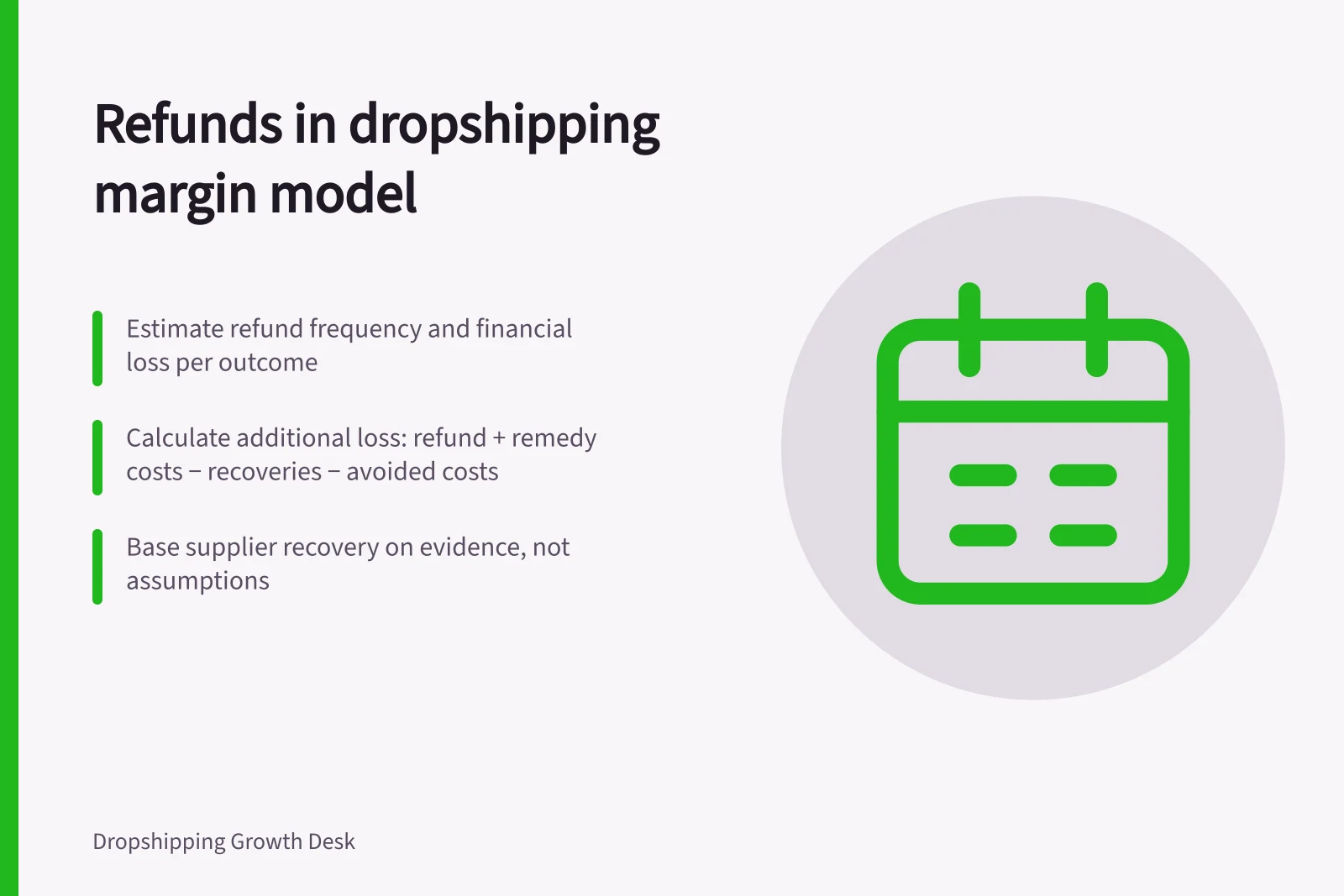
Allow for refunds by estimating the financial loss from each relevant outcome and how often it occurs in comparable orders. Reduce retained revenue for customer refunds, and count extra remedy costs once. Treat any expected supplier recovery separately from the remedy owed to the customer.
Separate the outcomes
One “returns percentage” can hide different costs. Group past orders, or clearly labelled planning scenarios, by outcome: full or partial refund, replacement, repair or another resolution. Record the reason and product alongside the amount. A change-of-mind return under store policy is a different planning category from a product-problem remedy.
The ACCC provides information about consumer-law rights and responsibilities. It does not resolve individual disputes or give legal advice about a right to a repair, replacement or refund.
Calculate the additional loss once
Start with contribution for an order that is kept. For each remedy outcome, calculate:
Additional loss = customer revenue returned + extra remedy costs − supportable recoveries − costs genuinely avoided or reversed.
Use the same GST basis for the kept order, refund and credit. If base revenue is already net of expected refunds, do not subtract them again. If replacement goods and delivery are separate costs, do not also add a lump sum that includes them. Check the payment provider’s actual fee treatment before assuming a charge is reversed.
Consider a hypothetical model on a consistent GST-adjusted basis. A kept order has $80 of retained revenue and $52 of ordinary variable costs, giving $28 contribution. Suppose five of every 100 comparable orders receive a full $80 refund. For each refunded order, assume a supportable $20 supplier credit and $8 of extra return handling, with no other costs reversed.
The additional loss per refunded order is $80 + $8 − $20 = $68. Spread across the original 100 orders, the allowance is $3.40 per order, leaving expected contribution of $24.60. These invented figures are neither a predicted refund rate nor a legal remedy for a particular case.
How to Calculate Refund Allowance in Dropshipping
- Determine contribution margin for a kept orderRevenue retained − variable costs
- Identify refund and remedy types by outcomeFull refund, partial refund, replacement, repair
- Calculate additional loss per refund eventCustomer revenue returned + extra remedy costs − supportable recoveries
- Spread loss across total ordersDivide total additional loss by number of comparable orders
- Adjust expected contribution marginSubtract allowance from original contribution
Base recovery on evidence
Check the supplier’s terms for the reason involved, such as a faulty item, wrong variant or transit damage. Establish whether a possible credit covers the item, original freight, return freight or a replacement shipment. Include only a recovery the evidence reasonably supports, and revise the allowance when the credit is confirmed or denied. A customer remedy should not depend on that decision.
Update the allowance
Use comparable orders for the same product, supplier and route where possible. Count affected orders, not support contacts: one order can generate several messages.
Allow time for later refunds before treating a recent cohort as complete. Show the order count behind a rate, especially when one case could move it sharply, and check a higher-cost scenario.
Revisit the allowance after a change to the product, supplier, packing, delivery route or returns policy. If repeated remedies reveal a listing or supply problem, address the cause as well as the margin.