Returns & Refunds
Dropshipping product compliance
Check the exact dropshipped item, Australian product safety requirements, supporting evidence and buyer warnings before listing or continuing sales.
An Australian dropshipping store must check that each product it offers can be supplied safely and lawfully in Australia. A supplier may hold and dispatch the stock, but the online seller still has product safety responsibilities. Before listing an item, identify what will ship, find the applicable requirements, assess the evidence and check the safety information buyers will receive.
Australian product safety laws apply to online businesses at every stage of the supply chain. Under the Australian Consumer Law, a supplier includes manufacturers, importers, distributors, retailers and hirers, and supply includes the sale or resupply of goods. Using a third party to hold and send the goods does not remove the retailer from that responsibility.
Identify the supplied item
Record the supplier SKU, model, variant, revision, included components and packaging. Ask whether the supplier may use another factory or substitute a product when stock runs out. Paperwork for a similar item does not establish compliance for the one a customer will receive.
Check the rules
Search current Australian mandatory standards and product bans by the item’s features and intended use. Check recalls by product, brand and model. Read the scope and exclusions of any potentially relevant rule.
A mandatory standard may address performance, contents, packaging or labelling. Many products have no applicable mandatory standard; that does not establish that they are safe.
If classification remains unclear, obtain the missing technical details or competent product-specific advice before listing. An overseas certificate or general supplier assurance does not settle an Australian requirement.
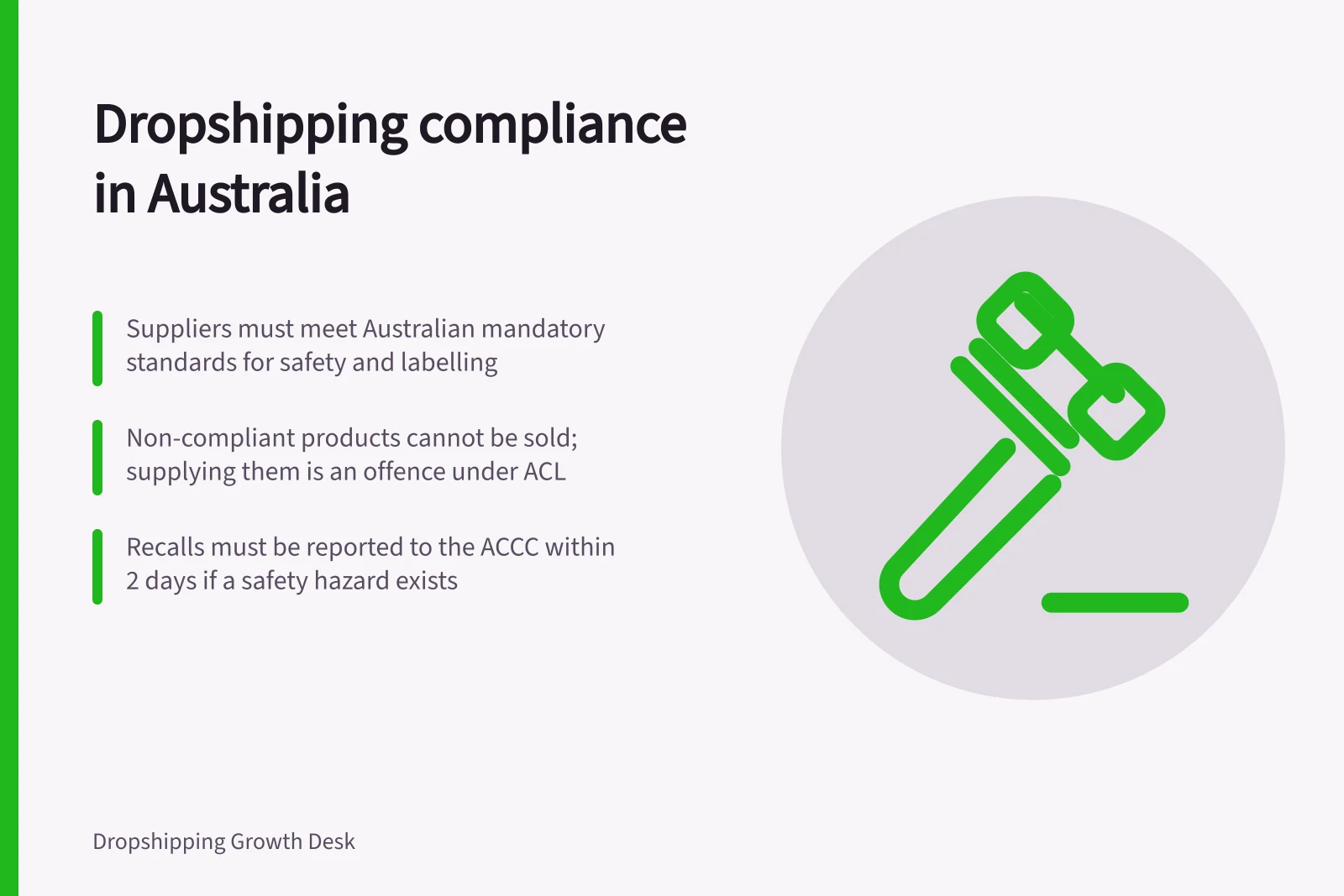
Mandatory standards set compulsory safety or information features for specified products, and products must meet any relevant requirements before supply. These can concern performance, composition, contents, manufacture or processing, design, construction, finish, packaging or labelling. Mandatory information standards can also cover information that helps buyers decide, such as ingredient labelling for cosmetics or care labelling for clothing and textiles.
Industry standards may be voluntary and can address issues beyond safety; they are not the same as a mandatory standard. Australian mandatory standards and bans are made when evidence shows a high risk of serious injury, serious illness or death.
Key Australian Product Safety Requirements
- Mandatory StandardsSet compulsory safety or information features for specified products
- Product BansProhibit supply of high-risk items that could cause serious injury or death
- ACCC RecommendationUse reliable, independent, preferably accredited laboratories for testing
- Recall NotificationReport to ACCC within 2 days if a safety hazard or incident occurs
Assess the evidence and buyer information
Ask for testing, certification or other evidence suited to the applicable requirement. Match the document’s product identification, tested configuration, requirements, results and conditions to current stock. Where laboratory accreditation is cited, check that it covers the relevant testing. Accreditation is recommended in Australian product safety guidance, but it does not prove that later stock matches a tested sample.
Check required markings, warnings and instructions on the product, packaging, accompanying material and, where relevant, the online offer. The applicable rule determines the wording and placement. A warning in a listing cannot be assumed to replace one required on a package.
Testing can help establish whether a product meets a mandatory standard or falls within a ban. The ACCC recommends reliable, independent and preferably accredited laboratories; suitable in-house testing or written certification from a certification agency are also options. A pre-production sample tested without further quality assurance may not represent products later supplied to consumers.
For an online offer, provide useful product safety information in appropriate languages. Relevant information can include warnings, labels, age-grading for children’s products, product descriptions, good-quality images and ingredients lists, particularly for cosmetics and toiletries. Make the business’s contact details clear so buyers can raise safety concerns.
Make the release decision
Treat release as a decision about whether the identified product may be supplied in Australia, not simply whether the supplier can dispatch it. Do not offer a product that is banned or fails an applicable mandatory standard; supplying non-compliant goods is an offence. If a mandatory standard does not apply, the product still needs to be safe and meet consumer guarantees, including acceptable quality and fitness for purpose.
A release decision should account for the product and the information buyers need to make an informed choice. If important safety or product details remain uncertain, hold the listing until they are resolved rather than relying on a general assurance from the supplier. Keep the basis for the decision with the item record so it can be reconsidered if the product or applicable rules change.
Record the decision and respond to changes
Keep the item version, requirements checked, evidence assessed, unresolved questions, decision and date together. Make the listing available only when material questions are resolved. Reassess it if the supplier changes the product, packaging or fulfilment source, or if a relevant rule or recall changes.
If a credible safety concern arises after listing, pause affected new sales while its scope and risk are assessed. Identify open orders and customers who may already have received the product. Assess recall and incident-reporting duties promptly where the facts warrant it. Taking down a page alone does not address products already supplied.
If you discover that a product supplied was unsafe, stop selling it straight away and communicate the concern to affected customers. A safety issue calls for an assessment of the product, defect or dangerous characteristic, and hazard to understand how the product may cause harm. If recall action is taken, notify the ACCC within 2 days; the ACCC also says to notify it within 2 days if a safety incident has occurred.
A recall is required if a product is a safety hazard, does not comply with a mandatory standard or is banned. A recall aims to remove the hazard from consumers and the marketplace; the remedy must also respect Australian Consumer Law rights, which include repair, replacement or refund and compensation for damages and loss.
Communicate clearly about the danger and what consumers should do, then track whether the recall is effective and adjust it if needed.
Report a death, serious injury or serious illness resulting from a consumer product you supplied. A recall notification can also include a mandatory report about such an incident. Keep customer communication and incident and recall actions with the product record so the response can be tracked and reviewed.
In this guide
- Checking applicable product requirements before listingIdentify an exact dropshipped item, check Australian mandatory standards, bans and recalls, and record which requirements apply.
- Requesting evidence that matches the exact supplied itemAsk a dropshipping supplier for item-specific evidence, then check the tested model, Australian requirements, report limits and current stock.
- Reviewing warning labels and instructionsCheck product markings, packaging, instructions and online warnings against the applicable Australian requirements and the version being supplied.
- Removing a product when safety information is unresolvedPause affected sales, trace open and completed orders, assess customer risk and reporting duties, and document when sales may resume.