Returns & Refunds
Part of Dropshipping returns and refunds
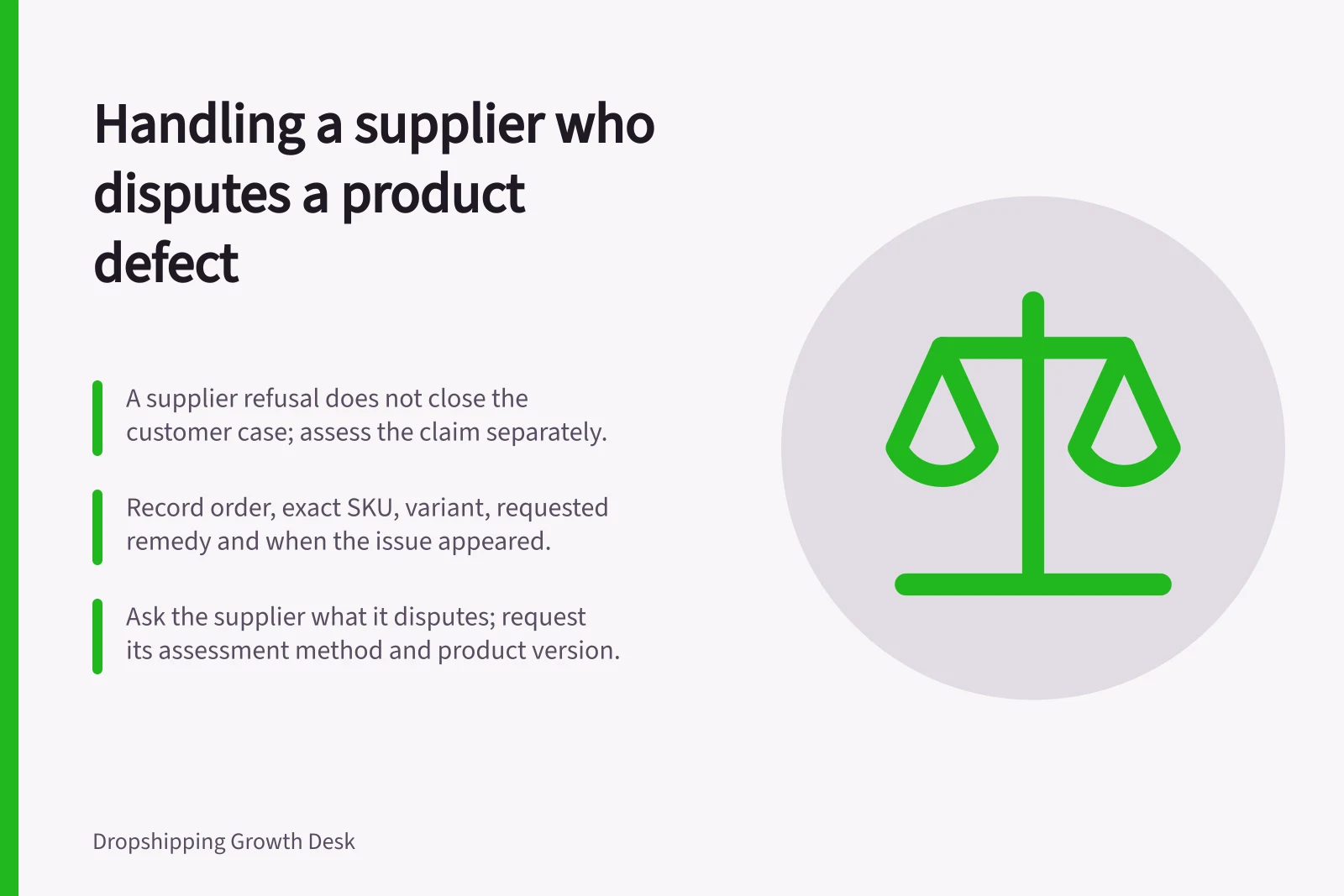
Handling a supplier who disputes a product defect
Clarify a supplier’s objection, assess the customer’s defect claim and pursue any separate recovery.
When a supplier rejects a defect claim, identify exactly what it disputes. Assess the customer’s claim on its own evidence. Treat the store’s possible recovery from the supplier as a separate decision. A supplier refusal does not close the customer case.
Handling a supplier defect dispute
- Identify the disagreementRecord the customer account, order, exact SKU and variant; ask the supplier what it disputes and why.
- Assess the customer claimUse the customer’s account and available evidence; arrange further assessment if a technical question remains open.
- Pursue the supplier claimSend order references, exact item, customer report, listing claim, useful evidence and a short timeline.
- Record the outcomeDocument the customer decision and evidence; keep the supplier claim open until its outcome is documented.
Customer claim vs supplier recovery
- Customer claimAssess on the customer’s account and available evidence; a supplier refusal does not close the customer case.
- Supplier recoveryAssess separately against the agreement and current legal guidance; mark a disputed credit as pending.
Identify the point of disagreement
Record the customer’s account, requested remedy, order, exact SKU and variant. Note when the issue appeared. Compare the received item with the listing, contents and instructions for that purchase. Ask for evidence that could clarify the alleged issue; photographs cannot establish every kind of fault.
Ask the supplier what it disputes. Does it claim the item differs from the order, the product was misused, a feature works as specified, damage occurred in transit or the evidence is insufficient? Request the assessment method, product version and observations behind its answer. A bare ‘no defect found’ gives the store little to evaluate.
What the supplier may be disputing
- Item differs from the order
- Product was misused
- Feature works as specified
- Damage occurred in transit
- Evidence is insufficient
Assess the customer claim
Use the customer’s account and available evidence to decide whether the reported issue is supported, its impact and what further checks are needed. A reported defect is not yet a confirmed finding.
If a technical question remains open, arrange an appropriate assessment. Tell the customer what will be checked and when the store will update them. Do not present the supplier’s refusal as a decision about the customer’s rights, or promise a particular remedy before the necessary facts are known.
If an inspection or return is needed, give clear instructions suited to the item and explain what the store will check and when it will update the customer.
For the applicable consumer-guarantee position, consult current ACCC guidance or obtain legal advice. The ACCC says it does not resolve individual disputes or give legal advice about a consumer’s right to a remedy.
Pursue the supplier claim
Send the supplier the relevant order references, exact item, customer report, listing claim, useful evidence and short timeline. Ask it to address the disputed point, identify any further evidence needed and state whether it proposes an assessment, replacement or credit. Set a follow-up date that fits the customer case.
Check the agreement for inspection, evidence and credit terms. Mark a disputed credit as pending.
If the supplier is also the manufacturer, assess any reimbursement request separately against the agreement and current legal guidance, after recording any remedy costs. The ACCC says it does not resolve individual disputes or give legal advice on whether a business is entitled to manufacturer reimbursement.
Record the customer decision and the evidence behind it. Keep the supplier claim open until its outcome is documented. Repeated reports about the same variant warrant investigation, but they do not prove that every unit has the same fault.
Evidence to send the supplier
- Order references
- Exact item and SKU
- Customer report
- Listing claim
- Useful evidence
- Short timeline
- Requested outcomeassessment, replacement or credit
- Follow-up date that fits the customer case