Stock Sync
Part of Moving beyond a single dropshipping supplier
Switching a successful product to stocked inventory
Decide when a proven Australian dropshipping product warrants owned stock, then plan batch costs, cash, stock control and changeover.
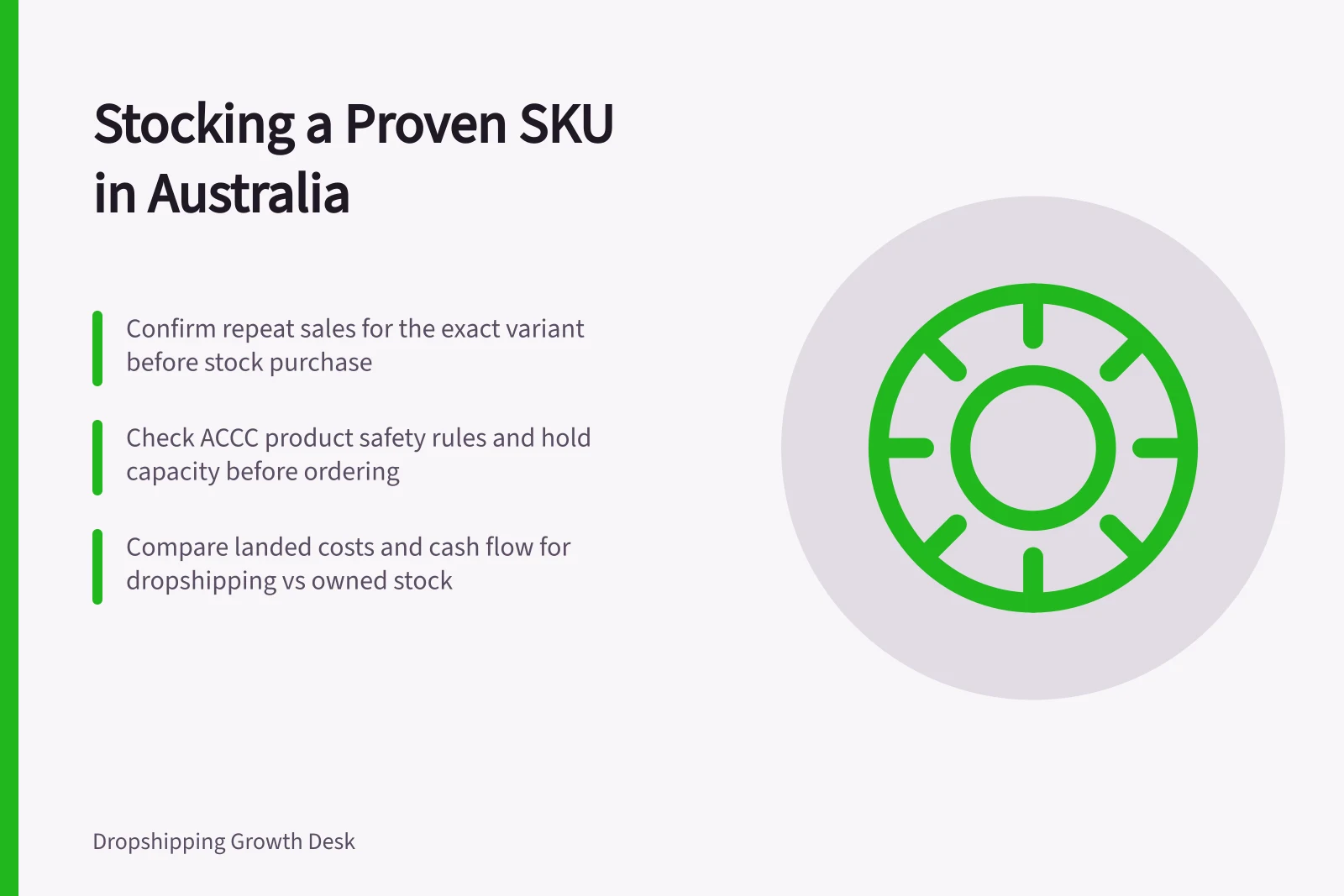
Treat a SKU as proven for a stock purchase when completed orders show repeat sales across periods for the exact variant, not just a promotion spike. Proceed only if the unsold batch exposure is affordable and the likely savings justify the extra costs and handling.
Check that you have somewhere to hold and count the units, and a fulfilment route that can meet the delivery offer.
Use evidence from the exact product
Review completed orders for the exact SKU and variant. Record units sold by period and destination, actual supplier and freight charges, delivery outcomes, returns and product changes.
Separate a repeat sales pattern from a short promotion or spike. Keep open orders and unresolved remedies visible because their final costs are not yet known.
Request a purchase quote for a quantity the business can afford to hold. Confirm the item revision, minimum order, payment timing, inbound freight and any process for changing materials or components.
ACCC Product Safety guidance says businesses supplying consumer products in Australia are legally responsible for product safety, including products subject to mandatory safety standards or bans. Check the applicable standard or ban for the stocked version before selling it.
A pre-production sample tested for safety is generally not enough without further quality assurance. Ask for written evidence of compliance, such as test reports or third-party certification, and check the supplier’s quality checks and pre-shipment inspection process.
Pre-Stock Purchase Checklist
- ✅ Review completed orders for exact SKU and variantVerify repeat sales across time periods, not just promotions.
- ✅ Confirm product safety complianceCheck mandatory standards via [Products Safety Australia](https://www.productsafety.gov.au/business/know-how-to-sell-safe-products/how-to-source-and-test-products).
- ✅ Request written proof of complianceRequire third-party test reports or certification from supplier.
- ✅ Obtain purchase quote with full termsInclude MOQ, payment timing, freight, and material change process.
- ✅ Identify storage and fulfilment capacityConfirm space and process can meet delivery commitments.
Compare cost and cash separately
Use the same selling price, destinations and GST treatment for both routes. Compare per-order contribution by subtracting product, fulfilment, variable selling and evidenced return or remedy costs from customer revenue.
For dropshipping, use the current supplier charge and freight. For owned stock, use the landed cost of each unit sold, then add relevant costs not already included, such as ordering, insurance, storage, financing, spoilage and labour to receive, store, pick and pack.
Assess damaged or unsold units separately, without charging the same unit twice. If a third-party warehouse will hold stock, get its receiving, storage and dispatch terms.
Make a separate cash forecast using payment timing, inbound freight and expected sales receipts. Stock on hand ties up money until it sells, and the batch and freight may need to be paid before sales recover the outlay.
For the same review period, divide additional fixed costs by the net per-unit saving to estimate how many units must sell to recover those costs. If there is no positive per-unit saving, sales will not recover fixed costs through that saving; also show the cash still tied up if fewer units sell.
Dropshipping vs Stocked Inventory: Cost and Cash Impact
- Cost Component
- Dropshipping
- Product & freight cost
- Current supplier charge and freight
- Fulfilment labour
- None (supplier handles)
- Storage & insurance
- Not applicable
- Financing (tied-up capital)
- Not applicable
- Landed cost (stocked)
- Product cost + inbound freight + duties + handling
- Fulfilment labour
- Picking, packing, dispatching
- Storage & insurance
- Monthly warehouse fees, insurance
- Financing (tied-up capital)
- Payment before sales recovery; tied until sale
Make stock control operational
Identify who owns and counts the units, where they are held and who can release them for sale. Track received, damaged, reserved, sold and returned units against the correct SKU.
Base replenishment decisions on observed order pace and actual lead time. Keep stock records and conduct regular stocktakes to monitor availability and avoid shortages or over-ordering.
Set a cutover point after the stock has been received and counted. At that point, update availability and delivery information only for units ready to dispatch; a purchase order is not stock on hand.
Assign each customer order to one fulfilment route. Older open orders may remain with the dropshipping supplier while new orders use owned stock.
Preserve the source and status of every open order line. Check reserved quantities at cutover so stock assigned to one order is not offered for another.
Start with a manageable batch
Buy a quantity whose unsold exposure the business can carry. Compare actual picking, packing, delivery, customer issues and cash recovery with the estimate.
Review units sold and remaining, damaged stock, returns, delivery outcomes and whether the stocked version matched the offer. Base any reorder on observed results and the cash still available.
Key Metrics for Stocked Inventory Decision
- Unsold exposure risk
- Affordable for business to carry
- Per-unit savings (if any)
- Positive net saving after all costs
- Cash tied up in stock
- Batch cost + freight paid before sales recover outlay
- Break-even units required
- Fixed costs ÷ net per-unit saving