Pricing & Margins
Part of Dropshipping pricing and margins
Comparing bundled offers with single-product sales
Compare bundle and single-product contribution using fair basket alternatives, actual fulfilment costs and substantiated saving claims.
Compare a bundle with the purchase the customer would otherwise make. A bundle can increase order value, while its discount, extra goods, delivery and remedy costs reduce the amount retained. Decide whether the bundle adds contribution under a plausible order mix, including the possibility that buyers would have purchased both items anyway.
Choose a fair comparison
Name the exact products and quantities in the bundle. Match the comparison to the decision:
- The main product alone:
- Would the bundle prompt an additional item purchase?
- The same items at normal prices:
- Does the bundle discount a basket the buyer already wanted?
- The items in separate orders:
- Would combining purchases save an actual order or freight charge?
Do not mix the most favourable assumptions from all three cases. Apply the same destination, GST basis and treatment of payment, acquisition and support costs. Recalculate those costs when the order shape changes them.
Calculate each whole-order contribution
For each alternative, subtract the supplier cost of every item, all applicable delivery and handling, payment charges, acquisition, support and expected remedies from retained customer revenue. Confirm whether the supplier can pack the items together. A bundle shown as one offer may still come from separate warehouses in separate parcels, with separate freight bills.
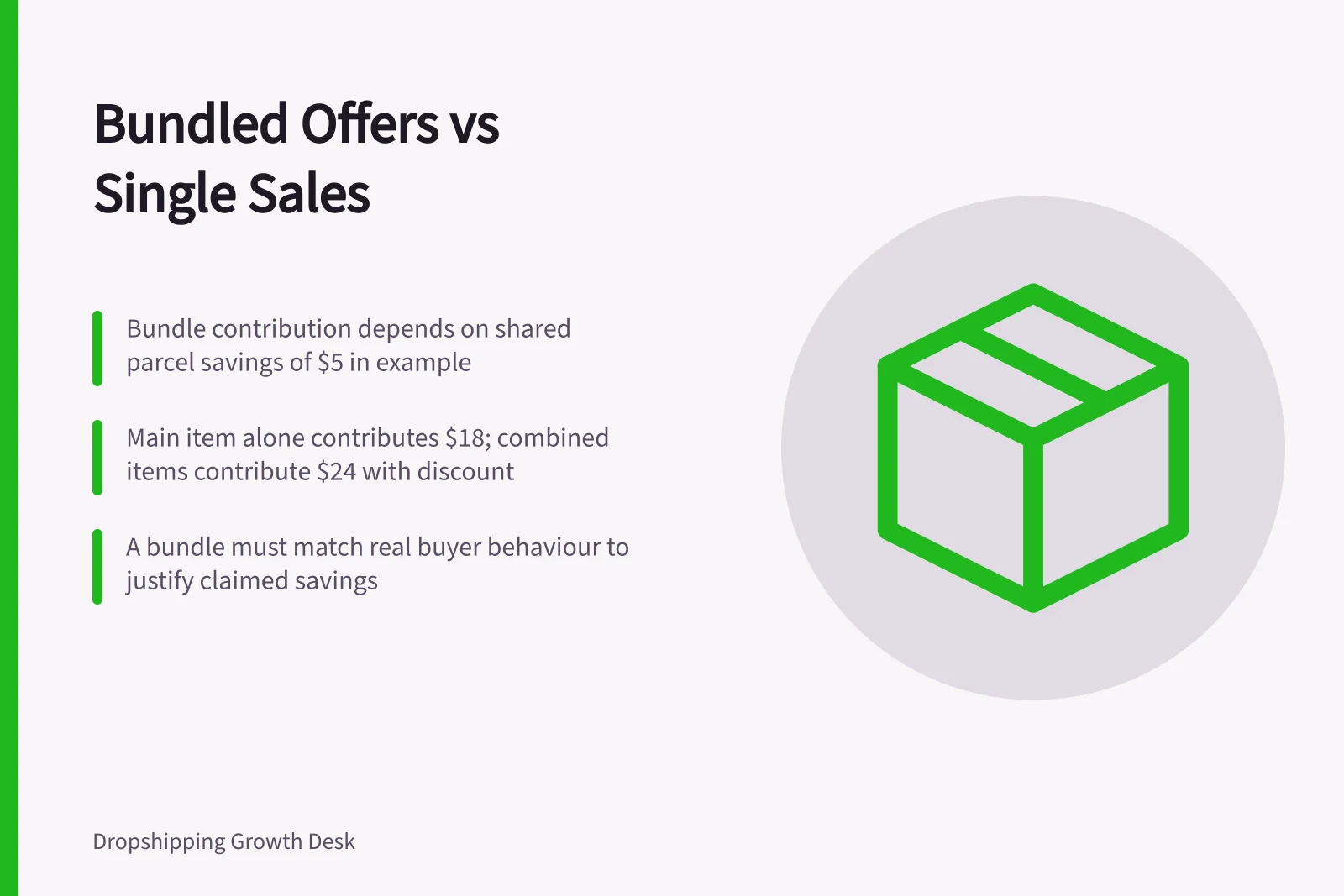
A hypothetical example shows why the baseline matters. Item A contributes $18 alone; item B contributes $8 alone. Combining them changes no other cost except a $7 bundle discount and a confirmed shared parcel saving of $5, so bundle contribution is $18 + $8 − $7 + $5 = $24.
That is $6 above selling A alone, but $2 below the $26 from selling A and B separately at normal prices. Without the parcel saving, bundle contribution falls to $19. These invented figures are not supplier rates or evidence of buyer behaviour. Recalculate any payment, acquisition or support cost that differs in a real combined order.
Compare contribution per order and, where useful, per item. A higher order value does not guarantee a higher margin percentage. A bundle with a lower percentage margin might still add contribution if it prompts a purchase that would not otherwise happen; the store needs its own evidence of that behaviour.
Check the buyer promise
State what the bundle contains and any exclusions. Confirm stock for every component and make clear when items may arrive separately. An incomplete bundle can cause a customer problem even when the main item is available.
A claimed saving needs a genuine comparison. Check the prices and terms used to calculate “save $7”.
A missing, faulty or misdescribed component may require a remedy that depends on the facts. Include possible replacement shipment or refund costs in the model. Do not assume a supplier credit equals the store’s obligation to the customer.
Ensure Compliance and Accuracy in Bundle Offers
- Clearly state all items in the bundleYes
- Confirm stock availability for every componentYes
- Disclose if items may arrive separatelyYes
- Verify genuine price comparison for 'save $7' claimYes
- Include replacement or refund costs in modelYes
Decide from the order mix
Record bundle orders, sales of the main item alone, and orders containing both items at normal prices. Compare their contribution and remedy costs using the same period and delivery routes. Those observations can show the order mix; by themselves, they do not prove the bundle caused an additional purchase.
Keep or revise the bundle based on the contribution it can reasonably support and a clear buyer benefit. Remove any saving claim that cannot be substantiated. If the calculation depends on a shared parcel that does not occur, recalculate the offer before relying on that price.
Pros and Cons of Bundled Offers in Australian Dropshipping
- ProsHigher order value, potential for increased customer satisfaction, reduced shipping costs with shared parcels, can prompt purchases that wouldn’t otherwise occur
- ConsRisk of incomplete bundles, higher remedy costs if components fail, misleading savings claims, possible failure to deliver on promised delivery times, increased complexity in inventory and fulfilment tracking