
Pricing & Margins
Part of Dropshipping operations for Australian online stores
Estimating whether a dropshipping offer can be profitable
Estimate a dropshipping offer using per-order contribution, fixed costs, sensitivity checks and completed-order records.
Estimate an offer by subtracting variable order costs from the revenue the store expects to retain. Then check whether the remaining contribution covers fixed costs at a plausible order volume. The supplier’s item price alone cannot answer the profitability question.
Build a consistent per-order estimate
Start with what the customer pays for the product and delivery, then account for refunds and GST consistently. Confirm the GST treatment for the business and supply route. Use a supplier quote for the exact SKU, destination and shipping service; a catalogue price may omit charges that appear when placing an order.
Include the variable costs relevant to the offer:
- supplier item, packing and shipping charges;
- payment and platform transaction charges that vary with sales;
- customer acquisition cost, accounting for campaign spend across the orders it produces;
- support and fulfilment labour that rises with order volume; and
- expected refunds, replacements, return freight or other remedies, allowing only for supplier recoveries that can reasonably be expected.
Do not count the same refund twice. If expected refunds reduce retained revenue, include only additional remedy costs in expenses. Keep estimates separate from invoices and completed-order records.
Assessing Dropshipping Offer Profitability
- Determine customer paymentPrice + delivery cost (including GST)
- Deduct refunds and GST treatmentAdjust for expected refunds; confirm GST liability (e.g., reverse charge if overseas supplier)
- Add variable costsSupplier item + packing + shipping; payment fees; platform fees; customer acquisition cost; support labour; remedy costs (e.g., return freight)
- Calculate retained revenueCustomer payment − refunds − GST (if applicable)
Calculate contribution and break-even volume
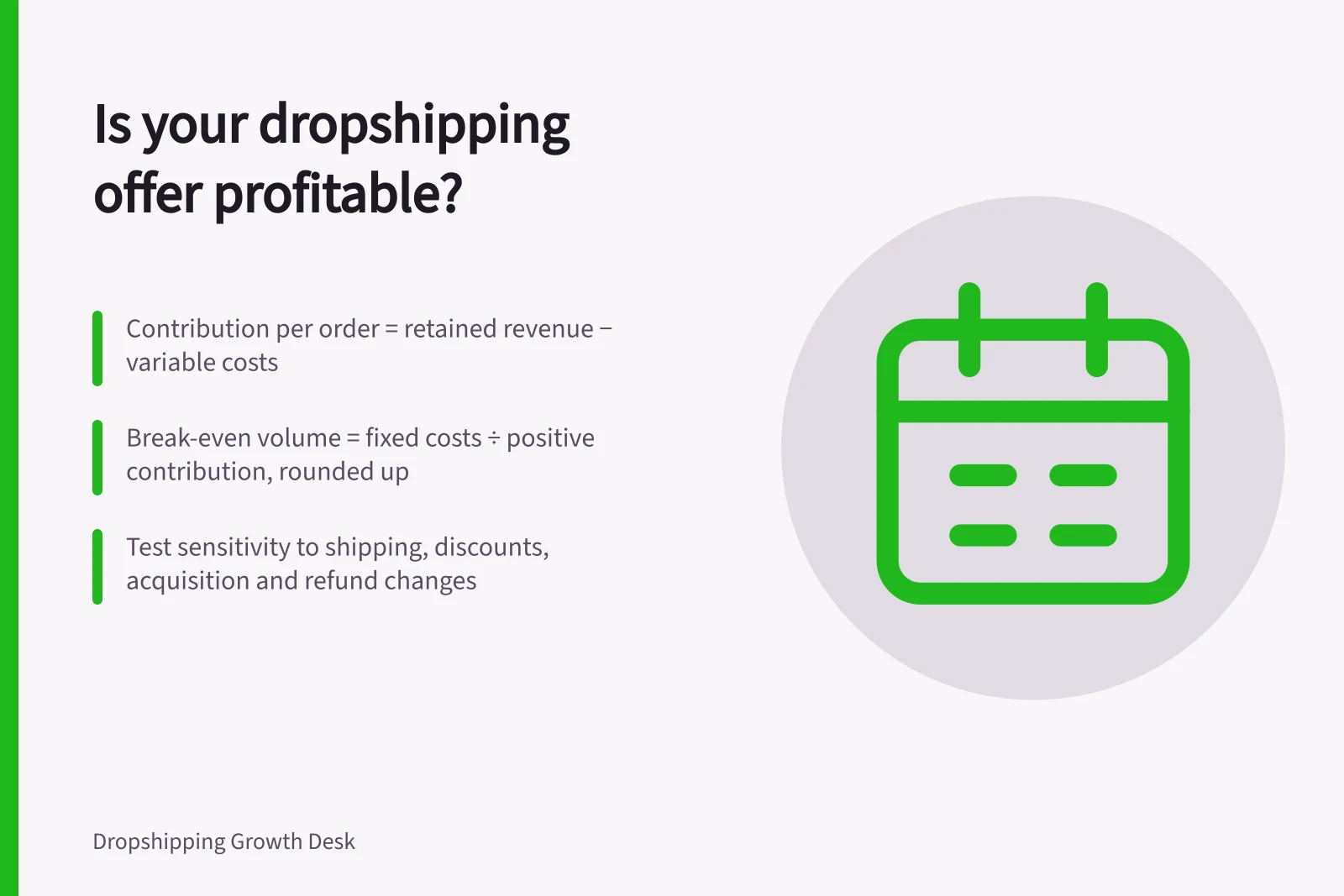
Contribution per order = retained order revenue − variable order costs. A positive contribution helps cover fixed costs; it is not net profit.
To estimate the order volume needed to cover fixed costs allocated to this offer, divide those monthly costs by a positive contribution per order and round up to a whole order. If contribution is zero or negative, increasing order volume alone will not cover those fixed costs.
Key Metrics for Profitability Check
- Contribution per order
- Retained revenue − variable costs
- Break-even order volume
- Fixed costs ÷ positive contribution per order (rounded up)
- Minimum margin required
- To cover delivery, processing and risk (ATO guidance)
Test what could change the result
Recalculate if supplier shipping rises, a discount cuts revenue, acquisition becomes more expensive or more orders need a remedy. If a modest change removes the contribution, the offer has little room for error. Check cash timing too: supplier and advertising payments may fall due before customer funds are available.
Australian Government guidance advises businesses to work out the margin needed to cover costs. Its shipping guidance says delivery cost should be reflected in product pricing or accepted as lower profit.
Pros and Cons of Using Estimates Before Launch
- Pros
- Enables pre-launch testing; identifies risk early; helps set pricing strategy
- Cons
- May misrepresent cash flow timing; overestimates recoveries; underestimates returns or shipping spikes
Replace estimates with order records
For completed orders, reconcile customer payments, supplier invoices, delivery charges, payment fees, acquisition spend and later remedies. Review results by product and delivery route. A single order cannot establish a stable acquisition or remedy allowance; label these as estimates until enough relevant history is available.
Set a decision point before launching or expanding the offer. Revise or pause it if contribution is negative at the intended price, the cash requirement is unaffordable, or the delivery and remedy arrangements cannot be honoured. Profitability depends on verified costs and observed orders, not a percentage added to a catalogue price.
Estimate vs. Actual Costs: What to Track
- Estimated Cost
- Based on supplier quote, average CAC, assumed refund rate
- Actual Cost (after completion)
- Reconciled from invoices, bank statements, returns logs, platform reports