Pricing & Margins
Part of Testing a dropshipping business
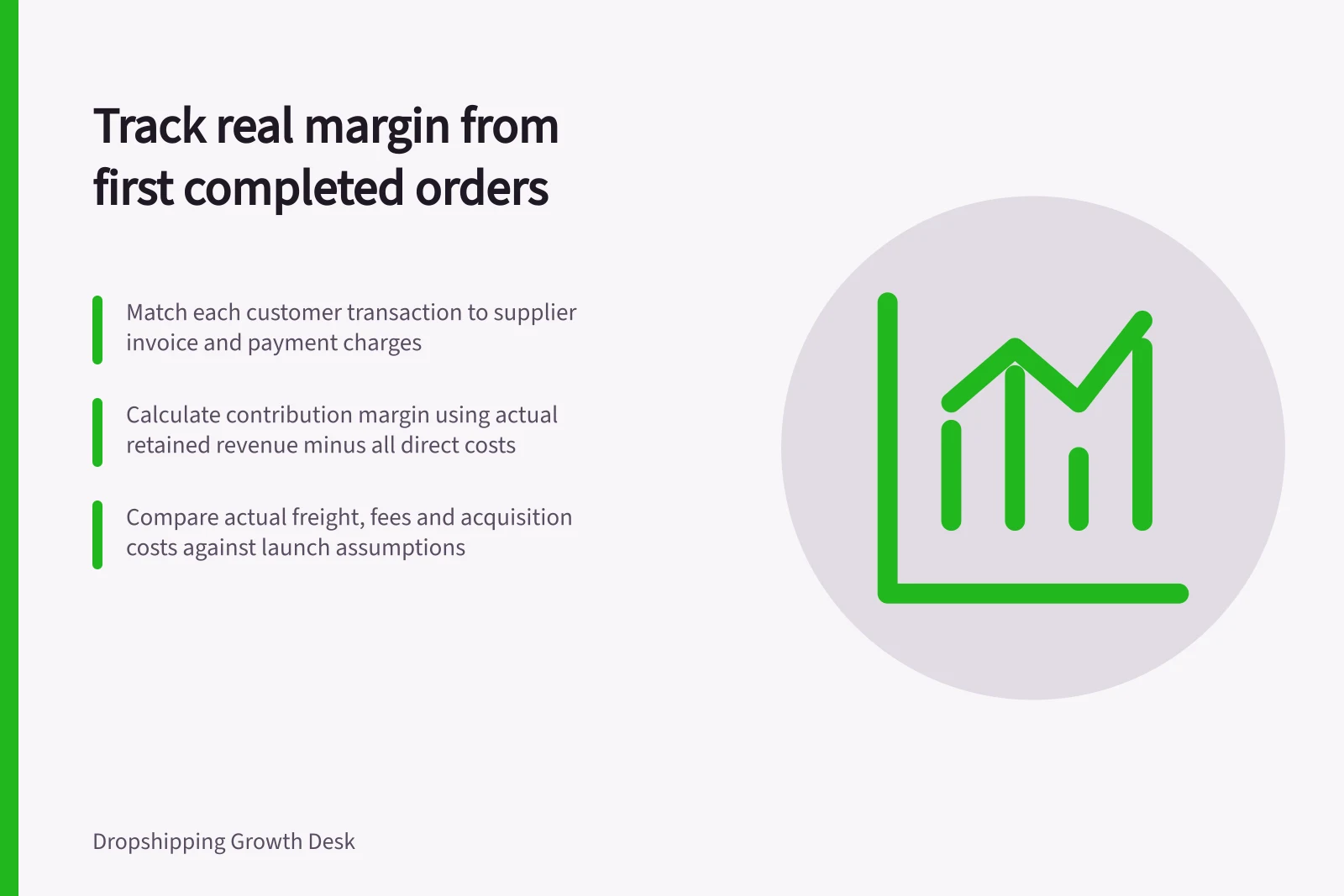
Tracking real margin from the first completed orders
Compare actual payments, invoices, fees and allocated acquisition costs with your launch assumptions for the first completed dropshipping orders.
Use the first completed orders to replace launch cost assumptions with recorded amounts. Match each customer transaction to its supplier invoice, payment charge and allocated acquisition cost. Keep open orders and later refunds visible so the early result is not mistaken for a lasting margin.
Reconcile each completed order
Start with what the customer paid for products and delivery after discounts. Identify the exact SKU, destination and supplier reference. Match supplier item, packing and freight charges, including a second parcel where one was needed. Use the payment provider’s actual fee and check whether a platform transaction charge is additional or already included.
Keep invoices and settlement records with the order. Australian business guidance calls for records of sales and expenses, and GST records where the business is registered. Calculate on a consistent GST basis suited to the business and transaction. Resolve uncertain treatment before presenting a final figure.
For this test, order contribution = retained customer revenue − supplier and delivery charges − payment charges − attributable acquisition, support and remedy costs. Divide contribution by positive retained revenue for a contribution margin. This is a management measure, not net profit; fixed costs still need covering.
Mark actual charges and allocations
Use invoices and transactions where available. State how acquisition or support spend was assigned to orders: the period, included spend, attribution rule and orders eligible for allocation. Do not treat an attributed sale as proof the advertisement caused it. Keep spend associated with orders still open visible beside the completed-order result.
If an order is refunded, reduce retained revenue by the refund and add only extra costs not already counted. Record a supplier credit separately when issued or settled. A requested credit is not recovered cash, and a customer remedy must be assessed independently of the supplier claim.
Exclude open orders from a completed-order average, but show their committed costs and possible obligations next to it. Revisit a closed cohort if a later refund or credit changes its result.
Compare the test with the launch estimate
For each product and delivery route, show the number of completed orders, total retained revenue, total contribution and contribution per order. Compare the actual supplier freight, payment charges, acquisition allocation and remedies with the assumptions recorded before launch. Identify which difference changed the decision; avoid hiding an expensive exception inside an average.
If ordinary completed orders contribute less than expected, revise the price, route or spend assumption before buying more traffic. A positive contribution from a few orders does not establish that fixed costs are covered or that future acquisition will cost the same.